Friday, October 13, 2017

A Civil War Tragedy – Vicksburg National Military Park, MS [October 9, 2017]


The Vicksburg Campaign is noted as one of the decisive battles during the American Civil War.  20,000 Americans in grey and blue uniforms died there, sometimes shooting at each other at point blank range.  So sad.  So tragic.  So many died that afterwards (sometimes many years afterwards), States erected huge monuments to their fallen, in the area where those troops had been located.  Not to glorify the act of war but to recognize the supreme sacrifices these men and their families had made, and to represent their grief.
The Illinois Memorial
Vicksburg is located on the banks of the Mississippi River.  In 1863, it presided high upon a hill overlooking a bend in the River (the Mississippi has since moved to another nearby location, but that is the nature of this river).  This was a strategic military location.  The Confederacy (South) used the Mississippi River to move troops and supplies.  The Union (North) felt that commanding the River would disrupt this movement and would also separate Texas, Arkansas and parts of Louisiana from the rest of the Confederacy.  Many battles were fought to maintain or gain control of the river.   Finally, in October 1862, there were only two places along the river still controlled by the Confederates, and one of them was Vicksburg.
The Shirley house was part of the Union lines and managed to survive despite the battle fought around it
General Grant tried unsuccessfully to win Vicksburg with his Union troops from March – May 1863.  His efforts (some of them fairly ingenious) were repulsed by Confederate troops led by Lt. General Pemberton.  So, Grant had his troops surround the town and laid siege for 47 days.  Skirmishes continued throughout the siege.  The townsfolk and the Southern soldiers starved and got sick.  Finally, Pemberton surrendered on July 4, 1863.
You pass under this arch to begin the drive around the battlefield

The park has a 14 mile road that leads you around the battlefield, which is dotted with memorials to the fallen. Blue signs indicate Northern troop locations and Red signs indicate Southern troop locations.  Some of them were so close to each other that it must have been a blood bath. 
One of the redoubts (or maybe it was a redan or a lunette).  Note the white smaller memorials and blue signs indicating Union troop placement.

Saturday, October 7, 2017

Return to St. Joe, Florida [October 1 - 6, 2017]


Lovely, lovely St. Joe

Over the years, we have accumulated a list of special places that we just HAVE to revisit some day.  St. Joseph Peninsula State Park in Florida is one such place.  It is the first of these spots to which we have returned.  But, I am getting ahead of myself.
A morning panorama
We had finished a week of Granny Nanny taking care of little three-month old Asher as his Mama returned to work.  It would be two weeks before the young family needed us again, so we headed off on adventures. As we listed all of the places we could go, St. Joe bubbled up as a possibility.  It was not too far away from Knoxville, AND their scallop season had been rescheduled to the Fall, ending October 8. 
Natural dunes
Deer family seen on a bicycle ride

St. Joe is just as breathtakingly beautiful, and relaxing as it was 3.5 years before.  Long, uninterrupted fine grained, white sand beaches beside the emerald green waters along the Gulf side of the peninsula.  Shallow, scenic St. Joe Bay on the other side of the peninsula.  Deer, egrets, heron, terns, gulls, pelicans, shorebirds.  Such a lovely, natural place.
Cape San Blas lighthouse, moved to the town of Port St. Joe

We rented a car and drove into the town of Port St. Joe.  The town was founded in the 1800s, but decimated down to 400 residents by a Yellow Fever epidemic.  The historic part of the current town are buildings dating from the 1930s.  The car also enabled us to take Tiki to a beach where dogs were welcomed.  The water was so clear that we could see her little paws as she swam toward us.  It was glorious swimming for us as well.
This is how you scallop in St. Joe...
Salinas Park pier, it is a long walk out to the submerged grass beds
Scalloping, it turns out, is done while wading in knee (or ankle) deep water in the submerged grasses of the Bay.  We were told that scalloping was hard this year; not many had been found.  In fact, over the years, they had been over-fished.  Then we were told that the Florida conservation folks had scooped up a bunch of scallops over the summer and had taken them away in cages to deeper water.  The animals would be brought back to spawn at the end of October in an effort to give the population a chance to recover.  We went to the southern end of the bay where they were said to be more plentiful, off of Salinas Park, where the locals go to scallop.  We waded through knee high water for several hours.  We did not see any scallops.  We did see many horseshoe crab couples, a few rays and a handful of blue crabs.  Even though we didn’t catch any scallops, it was fun to be out on the water.

Sunset

We weren't the only ones out to see the full moon in the morning...

We went out to the beach to see the sunset in the evening, and again to see the full moon set in the morning.  Even after 5 days, which if you have been following this blog you know that is a very long time for us to stay in one place, we had not done everything we wanted to do.  Guess we will just have to return again.  

We think we should return, don't you?
Coincidentally, Hurricane Nate was forecast to make landfall some place on the Gulf Coast, several days after we departed St. Joe.  As we headed North and West on to our next adventure, we shared the roads and campgrounds with RVers who were evacuated from the projected path of the storm. 

Monday, September 4, 2017

July and August Trips By the Numbers

Colonial Williamsburg "Dig"

Here are our numbers from the Colonial US History trip with Marina in July and the Eclipse/Scalloping trip in August.

Our July trip started with a drive down to Knoxville to pick up our granddaughter, Marina, from where she and her Mom were visiting our grandson, Asher, and his Moms.  We visited Monticello, Colonial Williamsburg, Jamestown, and the National Archives.  A magical history tour.

1,146 miles
8 days
3 states
5 places stayed
1607-1826 U.S. History years explored
4 historic sites
3 founding documents of the US
1 National Park
Eclipse Protective Eye Gear
Our August trip started with a drive down to Knoxville and then on to Ten Mile TN to camp under the totality of the Great American Eclipse.  From there, we traveled down to Homosassa Florida to snorkel for scallops, (finally) see manatees, and enjoy mer-folk.  We also spent an enjoyable afternoon at Cedar Key, an archipelago of tiny islands with a cute town and a sweet little museum (that is also a State Park) about the town.  We stopped off in Jacksonville Beach for a quick visit with Aunt Eva on the way home.

2,053 miles
19 days
6 states
7 places stayed
3 Florida State Parks
2 kayak paddles
2 scallop trips
17 1/2 dozen (210) scallops caught
2 minutes 38 seconds eclipse totality

Scallops on the half-shell

Saturday, September 2, 2017

Hunting the Blue Eyed Scallop – Homosassa and Crystal River FL [August 26 and 28, 2017]


Our beautiful scallop catch, do you see the blue eyes?

During the summer, a few counties in Florida allow snorkelers to harvest scallops from the shallow grass beds in the Gulf of Mexico.  Snorkeling for scallops!  We just had to try it!

If you don’t know what a scallop looks like before it is served on your dinner plate, think of the Shell gas station sign.  That is the shape of a scallop shell.  A scallop has two shells, one side is dark colored and one side is light colored. It propels itself by clamping and releasing the two shells together.  When it is hiding in the grass, the scallop opens the shells and filters plankton from the water.  There are two “kinds” of scallops.  Sea scallops are the big ones that live in deep, deep water out in the ocean and bay scallops are the small ones.  We were going after bay scallops.
Scallops are hard to see

Scallops are really hard to see; they blend into their environment.  You snorkel along the surface of the water, spot one, and then dive down 5-7 feet and pick it up, if it doesn’t scoot away from you first.  We developed a division of responsibilities.  Dana’s face mask has a 20 year old glasses prescription in it, so she sees underwater better than Russ does, whose mask has no prescription.  So, Dana would spot the scallop and point it out to Russ.  This was done with hand signals, because if you glance away, you won’t find the scallop again.  Then Russ would dive down to pick up the scallop (Dana is strictly a surface snorkeler…).  Sometimes, there would be another scallop lying nearby to be picked up in the same dive and once Russ got three.  Back up on the surface, Russ would hand the scallop (sometimes flapping its shells in an effort to get away) to Dana to put in the drawstring bag.  Team work!
Got one!

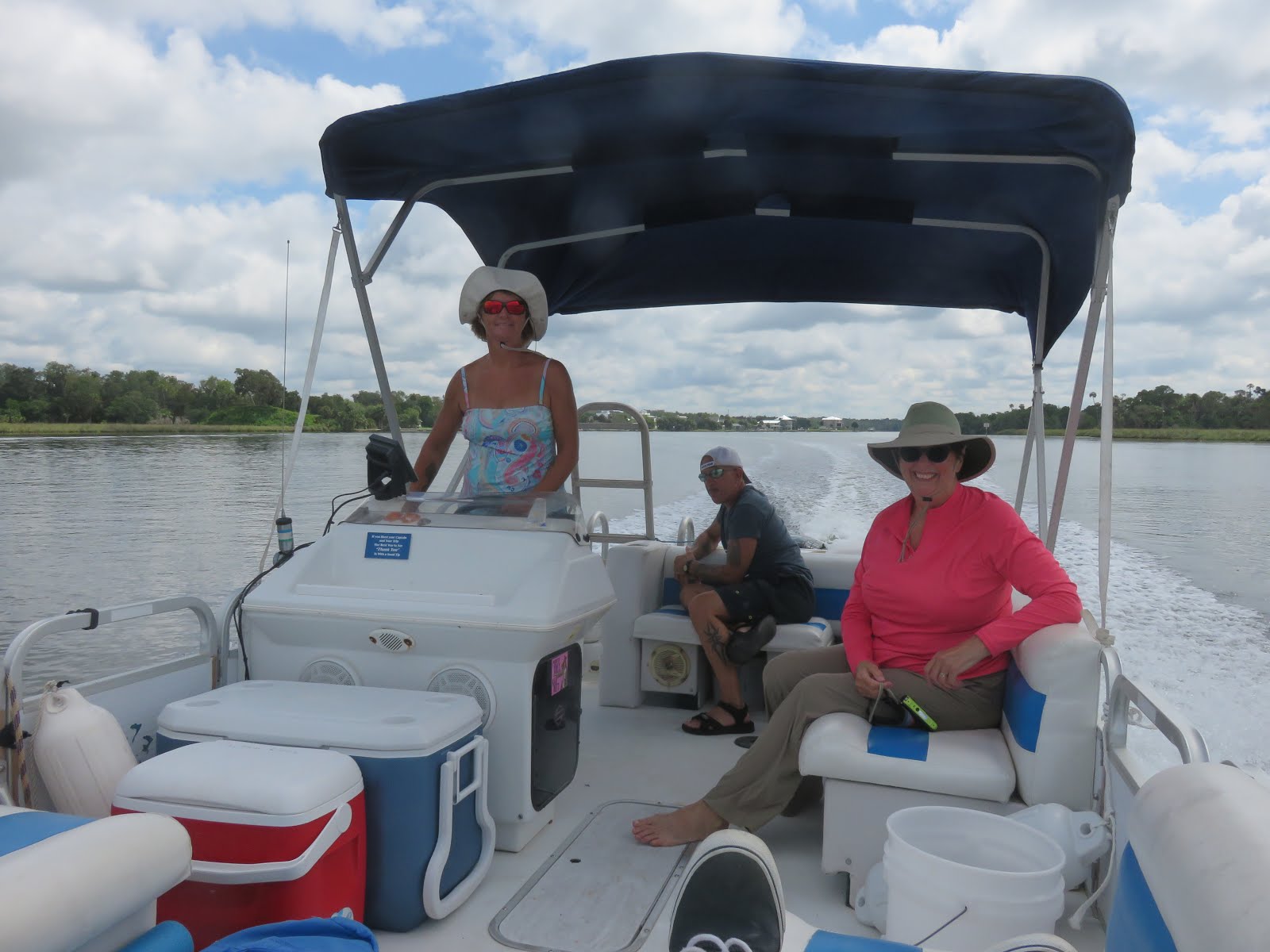
Our first trip was out of Old Homosassa with Captain Skip.  Captain Skip doesn’t have a web page, and doesn’t advertise with signs at the wharf.  His is a word of mouth business.  We like to ask local people for their recommendations, and this recommendation really paid off.  We were able to harvest three gallons of scallops in the shell.  They were transferred into buckets of water, and then into the cooler on ice.  This gave us a chance to admire them up close, and to see their many bright blue eyes (or sensors). 
Professional shuckers

At the dock, professional shuckers removed the meat from the shells for us, though Russ retained some to do back at the motor home to cook on the grill.  We have a video of Russ shucking.  It won't load out here on the road...we'll try to get it up when we get back to civilization and a stable wifi network.
**Imagine a video here**

Two days later we went scalloping again out of the town of Crystal River (just North of Homosassa) with Sea Education Adventures, Captain Laura and Alex (who was our swimmer and helped us catch the elusive scallops).  The grass beds off of Crystal River are thicker and so the scallops were harder to find.  A heavy wind and rain storm came up, cutting our scalloping short.  We high-tailed it back to the dock, having the salt water rinsed off of us by the rain.  The shuckers had (sensibly) gone home, so Russ shucked our 2 gallons of scallops himself in the motor home.  Needless to say, Russ’ rate was a lot slower than the professional shuckers.
With Captain Laura and Alex on the Crystal River
Both the Homosassa River and the Crystal River are formed by beautiful fresh water springs similar to the ones that we’ve described in previous posts.  The springs are very near to the Gulf of Mexico and the rivers are not very long.  The water is fresh and clear (should we say crystal clear), with a short brackish area just before joining the Gulf.  This part of Florida is called the Nature Coast.  It is largely undeveloped.  There are no expanses of beaches; the coastline is mostly wetlands and mangrove stands.  A welcome change from the more touristy parts of the Sunshine State.
Shucking at home

Getting ready to cook on the grill


Deliciousness!

We had a great time snorkeling and catching scallops, and plan on a return trip. Oh, by the way, we had yummy scallop dinners both nights, and froze over half of our catch for deliciousness when we get home.
Oh happy day!